
By Steven Fletcher
Originally published in the Winnipeg Sun, October 18, 2026. View the original article ↗
Spend an afternoon watching the Legislature and you’ll hear one phrase again and again: “Is there leave?”
A lot of the day’s business runs on unanimous consent. Changing the order of business, waiving a rule, letting a member finish a statement after the clock runs out, all of it needs leave. If every member agrees, it happens. If one member says no, it doesn’t.
That’s any one of the 57 members, not a party or a caucus.
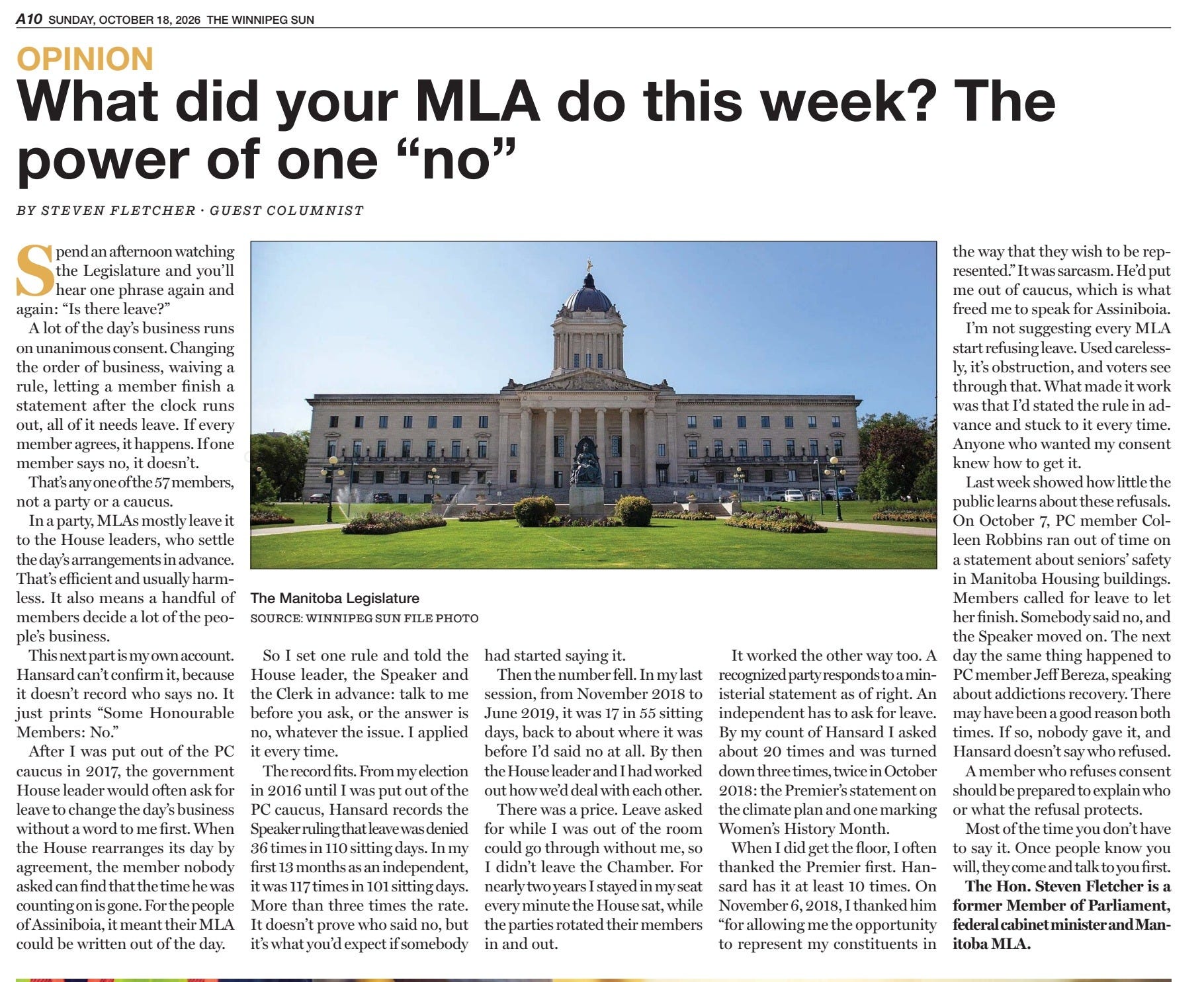
In a party, MLAs mostly leave it to the House leaders, who settle the day’s arrangements in advance. That’s efficient and usually harmless. It also means a handful of the Manitoba Legislature members decide a lot of the people’s business.
This next part is my own account. Hansard can’t confirm it, because it doesn’t record who says no. It just prints “Some Honourable Members: No.”
After I was put out of the PC caucus in 2017, the government House leader would often ask for leave to change the day’s business without a word to me first. When the House rearranges its day by agreement, the member nobody asked can find that the time he was counting on is gone. For the people of Assiniboia, it meant their MLA could be written out of the day.
So I set one rule and told the House leader, the Speaker and the Clerk in advance: talk to me before you ask, or the answer is no, whatever the issue. I applied it every time.
The record fits. From my election in 2016 until I was put out of the PC caucus, Hansard records the Speaker ruling that leave was denied 36 times in 110 sitting days. In my first 13 months as an independent, it was 117 times in 101 sitting days. More than three times the rate. It doesn’t prove who said no, but it’s what you’d expect if somebody had started saying it.
Then the number fell. In my last session, from November 2018 to June 2019, it was 17 in 55 sitting days, back to about where it was before I’d said no at all. By then the House leader and I had worked out how we’d deal with each other.
There was a price. Leave asked for while I was out of the room could go through without me, so I didn’t leave the Chamber. For nearly two years I stayed in my seat every minute the House sat, while the parties rotated their members in and out.
It worked the other way too. A recognized party responds to a ministerial statement as of right. An independent has to ask for leave. By my count of Hansard I asked about 20 times and was turned down three times, twice in October 2018: the Premier’s statement on the climate plan and one marking Women’s History Month.
When I did get the floor, I often thanked the Premier first. Hansard has it at least 10 times. On November 6, 2018, I thanked him “for allowing me the opportunity to represent my constituents in the way that they wish to be represented. “It was sarcasm. He’d put me out of caucus, which is what freed me to speak for Assiniboia.
I’m not suggesting every MLA start refusing leave. Used carelessly, it’s obstruction, and voters see through that. What made it work was that I’d stated the rule in advance and stuck to it every time. Anyone who wanted my consent knew how to get it.
Last week showed how little the public learns about these refusals. On October 7, PC member Colleen Robbins ran out of time on a statement about seniors’ safety in Manitoba Housing buildings. Members called for leave to let her finish. Somebody said no, and the Speaker moved on. The next day the same thing happened to PC member Jeff Bereza, speaking about addictions recovery. There may have been a good reason both times. If so, nobody gave it, and Hansard doesn’t say who refused.
A member who refuses consent should be prepared to explain who or what the refusal protects.
Most of the time you don’t have to say it. Once people know you will, they come and talk to you first.
The Hon. Steven Fletcher is a former Member of Parliament, federal cabinet minister and Manitoba MLA.